BESE newsletter
Ecosystem restoration highlights of 2023
You can find the newsletter here.
- Full scale restoration of an eroding riverbank in the Netherlands with BESE-elements.
Last winter (2022/2023), we constructed a nature-inclusive riverbank along a dike near Amsterdam, using BESE-elements to curb erosion and enhance biodiversity. By summer, the riverbank flourished with diverse flora and fauna above and below water. The water board ‘Hollands Noorderkwartier’ and Brunea Hoveniers facilitated this nature-based approach in Kwadijk.
- Best tested material for oyster reef restoration, our BESE-reef paste!
In Bretagne, France, the REEFOREST project by Ifremer tested various shapes of our BESE-reef paste for flat European oyster (Ostrea edulis) restoration. After 13 months, the paste attracted diverse organisms, with large oysters covering it. Wageningen University scientists will soon publish these findings, affirming BESE-reef paste as the top performer.
- Turning coral rubble into artificial reefs with BESE-mesh
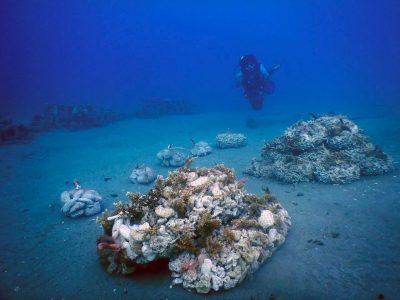
Inspired by oyster reef restoration, we innovatively replicated the method for coral restoration in northern Ambon. Collaborating with Pattimura University, we filled BESE-mesh with coral skeletons, creating stable artificial reefs. Plans for 2024 include monitoring the reefs to assess their success in providing settlement grounds for new coral larvae.
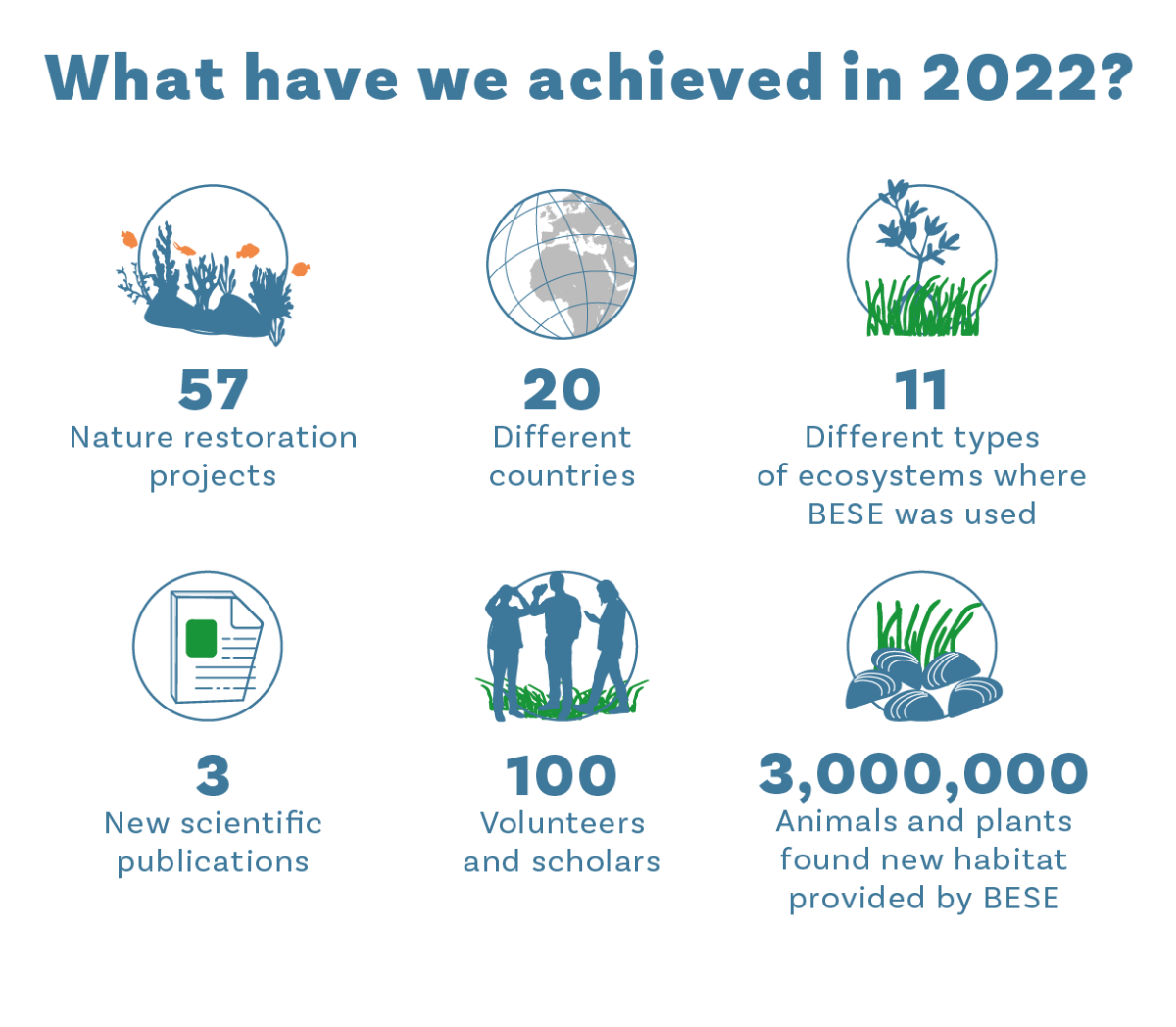
Ecosystem restoration highlights of 2022
You can find the newsletter here.
- Riverbank restoration in The Netherlands
In response to constant riverbank maintenance needs due to boat traffic erosion, BESE-elements offer an eco-friendly alternative to plastic reinforcement. By facilitating vegetation regrowth and wave energy protection, BESE-elements reduce plastic use and long-term maintenance costs. Two Dutch river projects are currently testing this principle, aiming for sustainable solutions.
- Seagrass restoration in Denmark, Corsica and Bonaire
For this highly productive ecosystem three restoration projects with BESE-elements started in 2022. In Denmark a project started to restore seagrass meadows with Van Oord and local enthusiasts. In Corsica techniques are tested to restore la Posidonia in collaboration with the University of Liège. And to wrap it up we recently went to Bonaire to restore seagrass in collaboration with STINAPA.
- Mangrove restoration in Ambon, Indonesia
We returned to Ambon for mangrove restoration. This time we set-up pilots with the BESE-elements on three sites, with different abiotic conditions. We trained local students from Pattimura University to maintain and monitor the progress of these pilots. Moreover, as presenters on a symposium on nature restoration we exchanged knowledge with 150 students of this same University.